How Does Glyco Harmony Work? The Plants Behind It
Quick answerGlyco Harmony pairs chromium with plants studied for blood sugar support.
The main ones are gymnema, green tea and Panax ginseng. Pooled human trials of those plants found fasting glucose a few mg/dL lower. It is a daily support supplement.
See the full blend.
What is the idea behind Glyco Harmony?
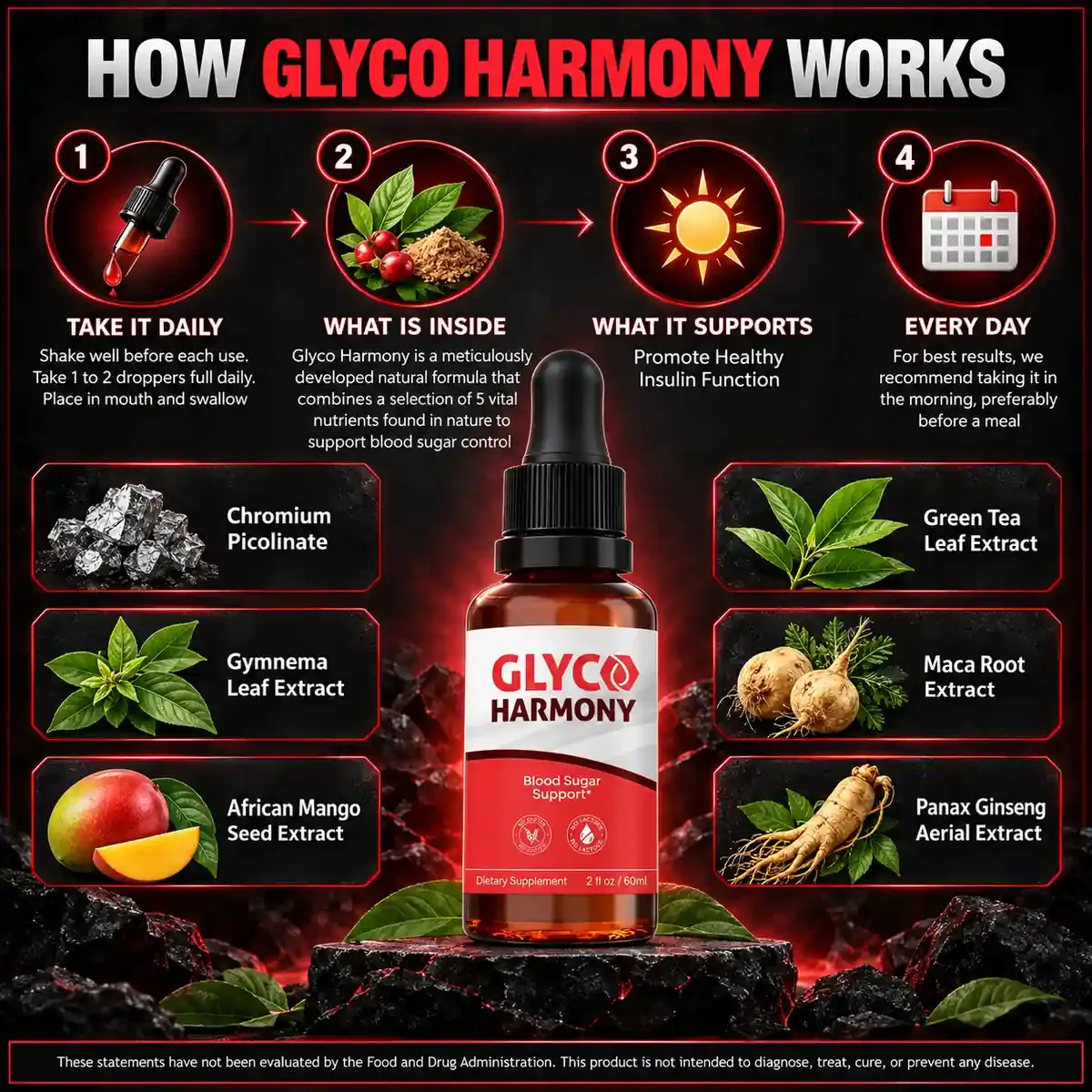
Glyco Harmony combines one mineral, chromium, with a blend of plant extracts. Several of those plants have been studied for how the body handles sugar. The label claim is simple: Blood Sugar Support.
No clinical trial of the finished drops has been published. So the honest way to explain how Glyco Harmony works is ingredient by ingredient. Each section below says what an ingredient was tested for, in whom, and at what dose. The full list is on Glyco Harmony ingredients.
What was gymnema studied for?
Gymnema leaf has a long history in traditional Indian medicine for sugar balance. Chewing the leaf briefly dulls the taste of sweet foods. Its compounds, called gymnemic acids, are the focus of most lab work.
Human studies are small. In an early study, 22 people with type 2 diabetes took 400 mg a day for 18 to 20 months alongside their usual drugs (Baskaran et al., 1990). It had no randomized control group. A later placebo-controlled trial gave 30 people with impaired glucose tolerance 300 mg twice a day (Gaytán Martínez et al., 2021). Their 2-hour glucose and A1C went down.
A pooled look at six gymnema studies found fasting glucose about 5 mg/dL lower, with no significant A1C change (McKennon, Endotext 2024). That is a modest, early signal.
What does chromium do in the body?
Chromium is a trace mineral that helps insulin do its job. Adults need about 25 to 35 mcg a day, and most get enough from food (NIH ODS, Chromium).
A review of 25 trials in people with diabetes found A1C 0.55% lower and fasting glucose 1.15 mmol/L lower on average (Suksomboon et al., 2014). Benefit was suggested above 200 mcg a day. The NIH calls the overall results mixed. It also notes chromium does not help glucose in healthy people.
What did green tea research find?
Green tea leaves hold catechins, a group of plant compounds. A review of 17 randomized trials with 1,133 people looked at catechin intake of 208 to 1,207 mg a day (Liu et al., 2013).
Fasting glucose was 0.09 mmol/L lower and A1C was 0.30% lower on average. Those are small shifts. They come from steady daily use over weeks.
What does the ginseng research show?
Panax ginseng has more blood sugar trials than most herbs. A review of 16 trials, lasting a median of 8 weeks, found fasting glucose 0.31 mmol/L lower, with no overall effect on A1C or insulin (Shishtar et al., 2014).
A newer review of 20 trials used 0.1 to 8 g a day and found fasting glucose about 7 mg/dL lower (Naseri et al., 2022). The A1C change was not significant. Most trials used the root. Glyco Harmony lists the aerial parts, the leaves and stems above ground.
Where does African mango fit?
African mango seed was studied for weight, not blood sugar alone. In one 10-week trial, 120 overweight adults took 150 mg twice a day (Ngondi et al., 2009). The extract's marketer helped fund that study.
A later review found only three small trials, with flawed reporting (Onakpoya et al., 2013). It called the effects on weight unproven. So African mango is best seen as a traditional ingredient with thin evidence.
Lab evidence vs human evidence: what is the difference?
Lab and animal studies show what a compound can do in a dish or a mouse. Human trials show what happens in people. Only human trials can tell you about blood sugar in daily life.
The table lists the human evidence for each lead ingredient. The research reviews are the strongest kind. The single small trials are the weakest. More detail is in gymnema and chromium: what the research says.
| Ingredient | Dose studied | Human evidence | What was found | Source |
|---|---|---|---|---|
| Gymnema | 400 to 600 mg a day | A few small human trials | Fasting glucose about 5 mg/dL lower in pooled data; no significant A1C change | (McKennon, Endotext 2024) |
| Chromium | 200 to 1,000 mcg a day | 25 trials in people with diabetes | A1C 0.55% lower on average; NIH calls results mixed | (Suksomboon et al., 2014) |
| Green tea catechins | 208 to 1,207 mg a day | 17 randomized trials, 1,133 people | Fasting glucose 0.09 mmol/L and A1C 0.30% lower | (Liu et al., 2013) |
| Panax ginseng | 0.1 to 8 g a day, mostly root | 16 to 20 randomized trials | Fasting glucose slightly lower; no clear A1C change | (Naseri et al., 2022) |
| African mango | 300 mg a day | One industry-funded 10-week trial | Studied for weight; a review called effects unproven | (Onakpoya et al., 2013) |
| Maca | 1.5 to 3 g a day | One trial on desire in healthy men | No human blood sugar data | (Gonzales et al., 2002) |
What do liquid drops change, and what do they not?
The drop format changes how you take Glyco Harmony. It does not change what the research found about each ingredient.
What drops change
- No pills to swallow; the dropper goes straight into the mouth
- You can choose 1 or 2 droppers a day, as the label allows
- Stevia and xylitol make the taste easy to handle
What drops do not change
- Faster absorption has not been measured for this product
- The amount of each blend ingredient stays unpublished
- The drops do not replace meals, movement or medicine
Format pros and cons are compared in liquid drops vs capsules.
How does Glyco Harmony fit into a normal day?
The routine is short. These four steps follow the label and keep your usual care in place. Timing and storage tips are on how to take Glyco Harmony.
Shake the bottle
Plant extracts can settle in a liquid. A quick shake mixes the drops before you fill the dropper.
Take 1 or 2 droppers
Each dropper full is the 1 ml serving. Place it in your mouth and swallow, as the label directs.
Keep a steady time
The ingredient trials used daily intake over weeks. A fixed time makes that easier to keep up.
Keep your usual care
Meals, movement, sleep and any medicine your doctor prescribed still come first. Keep checking your numbers as advised.
What do health agencies say about supplements for blood sugar?
They are cautious. The American Diabetes Association does not recommend herbal or mineral supplements, including chromium, for blood sugar benefit unless a person has a deficiency (ADA Standards of Care, 2025). The NIH says there is not enough evidence that any supplement helps manage or prevent type 2 diabetes (NCCIH, type 2 diabetes digest).
That is why Glyco Harmony is sold as support for normal function, not as a treatment. A product that claims to treat diabetes is a drug under the law (FDA and FTC, 2021).
On diabetes medicine?
Gymnema and ginseng may add to the effect of glucose-lowering medicine (LiverTox, Gymnema) (NCCIH, Asian Ginseng). If you take diabetes medicine or insulin, talk to your doctor before starting, and keep checking your blood sugar as advised. Never change your medicine on your own. More is on Glyco Harmony side effects.
How do the label amounts compare with the studies?
The amounts in Glyco Harmony are much smaller than the doses in the studies above. The whole 200 mg blend weighs less than one studied dose of gymnema. Chromium, at 0.7 mcg, is under 1% of 200 mcg.
That does not prove the drops do nothing. It means the trials describe the ingredients, not this product. The per-ingredient numbers are on Glyco Harmony Supplement Facts.
How Glyco Harmony works: FAQ
Has Glyco Harmony been tested in a clinical trial?
No trial of the finished product has been published. The research on this page tested single ingredients, usually at higher doses.
Which Glyco Harmony ingredient has the most research for blood sugar?
Chromium, green tea and ginseng each have pooled reviews of many trials. Gymnema has fewer, smaller trials. Maca has no human blood sugar research.
Does Glyco Harmony lower blood sugar?
It is not proven to, and it is not a treatment. Its label claim is Blood Sugar Support. Keep checking your numbers as your doctor advises.
Do liquid drops absorb faster than capsules?
No study of Glyco Harmony has measured that. Drops are easier to swallow, but the amount of each ingredient is what the research tied to results.
How long before Glyco Harmony does anything?
No timeline can be promised. Ingredient trials ran from 8 weeks to 20 months of daily use.
Why does Glyco Harmony use so many ingredients?
The brand chose a broad blend of 22 ingredients, from plant extracts to amino acids. The label does not explain the choice, and each one gets a small share of 200 mg.
Does Glyco Harmony work for people without diabetes?
The label claim is general Blood Sugar Support for adults. The NIH notes chromium does not help glucose in healthy people, and most trials enrolled people with high blood sugar.
Can Glyco Harmony be taken with diabetes medicine?
Ask your doctor first. Gymnema and ginseng may add to the effect of glucose-lowering drugs, so your doctor may want you to check your blood sugar more often.
Ready to try Glyco Harmony?
1 or 2 droppers a day, 60 ml per bottle, from $36 a bottle on the Buy 4 Get 4 pack with free US shipping, 6 bonus e-books on the larger packs and a 60-day money-back guarantee. Questions first? Call +1 (925) 231-0148.