
Glyco Harmony A1C: the terms explained and what ingredient trials found
Quick answerGlyco Harmony A1C: the label makes no A1C claim and no study of the finished drops exists. Trials of single ingredients found small A1C changes at doses far above this label. A1C looks back about three months, so a 60-day guarantee window is short for it. Take a baseline and ask your doctor which measure to use.
Key facts
- The label claims Blood Sugar Support* only. It makes no A1C claim.
- A1C shows average blood sugar over about three months, longer than the 60-day guarantee window.
- Trials found A1C 0.55% lower for chromium (25 trials) and 0.30% lower for green tea (17 trials); gymnema and ginseng pooled results were not significant.
- Chromium is printed at 0.7 mcg, against 200 to 1,000 mcg a day in trials.
- Never change diabetes medicine on your own. Glyco Harmony is a supplement, not FDA approved and not a treatment.
Does Glyco Harmony A1C support exist as a claim?
No. The label says Blood Sugar Support* and nothing about Glyco Harmony A1C. It also carries the FDA statement that the product is not intended to diagnose, treat, cure or prevent any disease. A1C is a lab number your doctor orders. A supplement label may not promise to move it, and this one does not.
That said, the search is a sensible one. If you are thinking of buying a blood sugar supplement, you will want to know what a number like A1C may do. So this post does two things. It explains the words, and it lays out what trials of the individual ingredients found on A1C, with the label amounts next to them.
What do the A1C words mean? A short glossary
| Word | Plain meaning | Why it matters here |
|---|---|---|
| A1C | Your average blood sugar over about three months, shown as a percent | Slow to change, so one meal barely moves it |
| Fasting glucose | Blood sugar after at least 8 hours without food | Can shift day to day |
| mg/dL and mmol/L | Two ways to write a glucose number | Studies use both; they are not the same figure |
| Baseline | Your first number, before you change anything | You can only compare against a baseline |
| Placebo | A look-alike product with no active ingredient | A trial without one is hard to judge |
| Randomized trial | People are placed by chance in a group | Stronger than an open study |
| Pooled result | Several trials combined into one summary | Sums up a pattern, not one person |
| Not significant | The change could have happened by chance | Do not read it as a real drop |
The prediabetes range is an A1C of 5.7% to 6.4%, and a fasting glucose of 100 to 125 mg/dL (NIDDK, prediabetes). Only a doctor can diagnose prediabetes or diabetes.
What did ingredient trials find about A1C?
Every result below is for a single ingredient at a studied dose. None is a study of Glyco Harmony.
| Ingredient | What was studied | A1C finding | Source |
|---|---|---|---|
| Chromium | 25 trials in people with diabetes, benefit mainly above 200 mcg a day | A1C 0.55% lower on average | Suksomboon et al., 2014 |
| Gymnema | 30 people with impaired glucose tolerance, 300 mg twice a day, with a placebo | A1C from 5.8% to 5.4% | Gaytan Martinez et al., 2021 |
| Gymnema | A pooled look at 6 studies | No significant A1C change; fasting glucose about 5 mg/dL lower | McKennon, Endotext 2024 |
| Green tea | 17 trials, 1,133 people, 208 to 1,207 mg catechins a day | A1C 0.30% lower on average | Liu et al., 2013 |
| Panax ginseng | 20 trials, 0.1 to 8 g a day, mostly root | A1C change not significant; fasting glucose about 7 mg/dL lower | Naseri et al., 2022 |
Read the pattern. The A1C moves are small, the groups are specific, and the gymnema result in a small placebo-controlled trial does not show up in the pooled data. The NIH Office of Dietary Supplements calls the overall chromium results mixed and of unclear value.
Why is 60 days a short time for Glyco Harmony A1C changes?
Because A1C looks back about three months. The guarantee window is 60 days from the purchase date. So by the time an A1C test could fully reflect a new habit, the refund window has closed. Roughly another month would have passed.
The ingredient trials ran from 8 weeks up to 20 months. No trial of the finished drops exists, so nobody can tell you how long to wait for a change, or whether one will come.
That does not mean you cannot judge the drops. It means A1C is the wrong yardstick inside 60 days. Your doctor may suggest a different yardstick, such as a meter reading at set times. Our results timeline page lays out what trials and buyers report.
Do not wait for a number to decide about your medicine
If you take diabetes medicine, never change it on your own because of an A1C result or a supplement. Talk to your doctor first.
If you want to try the drops with a doctor's go-ahead and a baseline in hand, the order page shows the packs and the 60-day guarantee before you pay.
See today's price and guaranteeThis site earns money when you order through its links. How we earn.
How do Glyco Harmony A1C label amounts compare with the trial doses?
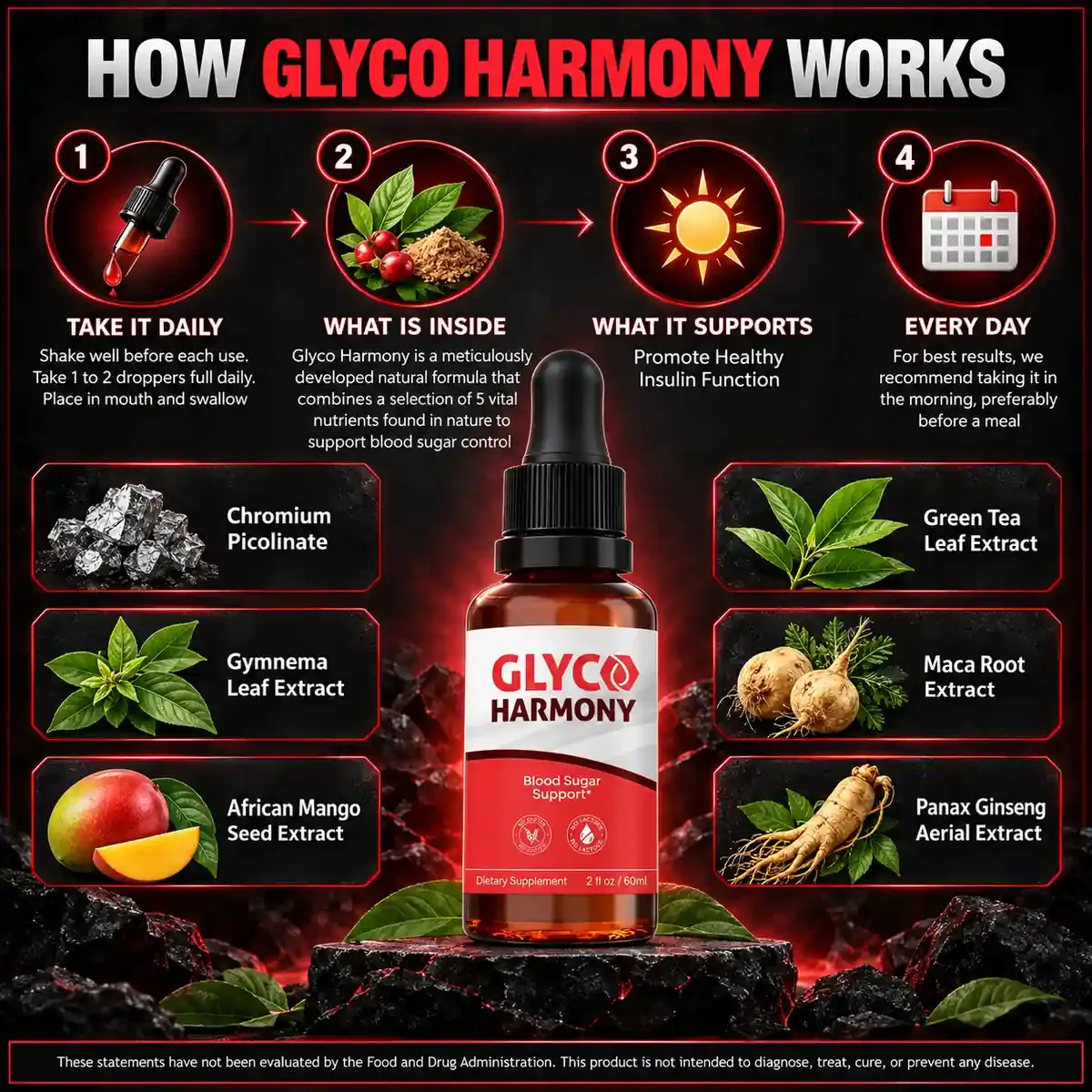
The gap is large. The blend order gives a ceiling for each ingredient, and every ceiling sits below the studied dose.
| Ingredient | Glyco Harmony at 1 dropper | Glyco Harmony at 2 droppers | Studied amount |
|---|---|---|---|
| Chromium | 0.7 mcg | 1.4 mcg | 200 to 1,000 mcg a day |
| Gymnema leaf extract | At most 25 mg | At most 50 mg | 400 to 600 mg a day |
| Green tea leaf extract | At most 28.6 mg extract | At most 57 mg | 208 to 1,207 mg catechins a day |
| Panax ginseng aerial | At most 16.7 mg | At most 33 mg | 100 to 8,000 mg a day, mostly root |
A lower dose is not proof of no effect. It means the trials do not describe this product. For the full math, see our post on reading a 200 mg proprietary blend.
What should you do around a Glyco Harmony A1C test?
Get a baseline before you start
Ask for an A1C or fasting glucose test and write down the date and the number.
Tell your doctor about the drops
List every supplement you take. Gymnema and ginseng may add to glucose-lowering drugs.
Keep medicine and habits steady
If you change food, walking and the drops all at once, a new number tells you nothing.
Retest on your doctor's schedule
Compare with your baseline, not with a single good day or bad day.
Make the refund choice on your own terms
The window ends 60 days after purchase. Decide using what you can see, such as your notes, not on a hope about a lab number.
If you want a log to copy, our 60 day record post has one.
How should you treat A1C claims you see online?
With care. Any page that says the drops lower A1C goes beyond the label. A product sold to treat or prevent diabetes counts as a drug, not a supplement, according to the FDA and the FTC (FDA and FTC, 2021).
Before you believe a number you see, ask who measured it, in whom, over how long and for which ingredient. If the answer is a testimonial, treat it as a story, not as a result. The Glyco Harmony home page sticks to the label wording for that reason.
Frequently asked questions
Does Glyco Harmony lower A1C?
The label does not claim it, and no study of the finished drops has been published. Trials of single ingredients at much larger doses found small A1C changes in some groups.
What is A1C?
A lab number for your average blood sugar over about three months. It is shown as a percent.
Will my A1C change in 60 days?
It may not, because A1C looks back about three months. The guarantee window is 60 days.
Which ingredients were studied for A1C?
Chromium, gymnema, green tea and Panax ginseng all have trials. Results were small, mixed or not significant, and all used larger doses than this label can hold.
Should I stop my diabetes medicine if my A1C improves?
No. Never stop or change medicine on your own. Talk to your doctor, who knows your history.
What is a good way to judge the drops?
Take a baseline, change one thing at a time, keep a weekly log and talk to your doctor about which measure to use.
Our view
Glyco Harmony A1C is a good question to ask and a hard one to answer. The label does not claim it, and the research is about single ingredients at doses the bottle cannot match. Honest words here are: small, mixed and unproven for this product.
If you want to know whether the drops suit you, A1C is too slow for a 60-day window. Use a baseline and the measure your doctor suggests, and keep the rest of your plan steady.
The numbers on a lab slip belong to you and your doctor. A supplement should never be allowed to talk you out of that conversation.
Medical note
Glyco Harmony is a dietary supplement. It is not FDA approved, and no supplement is. It does not diagnose, treat, cure or prevent any disease. If you have a medical condition or take medicine, ask your doctor or pharmacist first, and never change your medicine on your own.
Take a baseline, talk to your doctor, then see the packs and the guarantee on the order page if you decide to try the drops.
See today's price and guaranteeThis site earns money when you order through its links. How we earn.